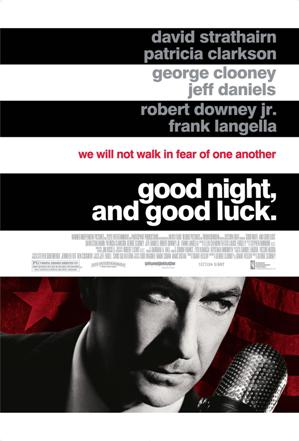
*The following review is in no way an endorsement of Mark Cuban, statements made by Mark Cuban and especially not basketball teams owned by Mark Cuban. Mark Cuban, the Dallas Mavericks and all associated parties remain the embodiment of the forces of darkness in my eyes.
Good Night, and Good Luck is an unusual film, a little off putting. The film chronicles Edward R. Murrow brilliantly played by David Strathairn and his staff as they take on Senator Joseph McCarthy and his committees on Communism in the United States government. As dramatic as that sounds, there never really is the amount of tension you might expect for such a dramatic moment in American history. I think this is intentional, thanks to co-writer/director George Clooney (written along with Grant Heslov), the idea is that McCarthy tries to get people wrapped up in fear, whereas Murrow and company rely on reason and intellect, daring to throw McCarthy's words back at him, which is pretty sweet. But there's never any melodrama, no theatrics, just the sense that these guys are just going to do their job, which they see as taking on McCarthy. It's all the more powerful because of it. There are also moments of levity such as Murrow's expression after having interviewed Liberace about his quest to find the perfect girl. By the way, they have DVDs of Murrow's Person to Person and they are just brilliant to watch. There's one where Charlton Heston just keeps plugging The Ten Commandments and it's like, "Dude, we know you're Moses, okay?" Also, one with newlyweds Paul Newman and Joanne Woodward who admit they pretty much pushed all their crap behind the cameras for the interview. Also, you can hear Paul bitch about having lost his electric orange juice squeezer in the move.
The cast is rounded out by Clooney himself, Robert Downey Jr., Patricia Clarkson, Frank Langella and Jeff Daniels. Ray Wise also makes an appearance as a depressed and despondent CBS anchor, who kills himself after being accused of being a Communist. There's also a pretty sweet Jazz soundtrack by Dianne Reeves, which is worth listening to on its own.
Now, the Mark Cuban comment. Mark Cuban put up some of the money for this movie. Why? I don't know, he's obviously bent on world domination and should be stopped, or maybe the refs weren't taking his checks that year and he needed somewhere else to put it. I don't like Mark Cuban, okay? I wouldn't take money from Mark Cuban. Someone would have to be dying before I would consider any situation in which I would take money from him. He just sits there and pouts during the games and looks like a jackass. I'm kind of sad I was giving him money when I saw this movie and that time I went to the American Airlines Center for NBA All Star Weekend, but I was only there because of DeJuan Blair! It is a nice arena, but you have to remember it is where evil lives and plays. Never forget that.
It seems bad to say now, but I never liked Elizabeth Taylor. You know how sometimes in life you just meet someone and you don't know why, but you take an instant dislike to them? Elizabeth Taylor is the cinematic equivalent of that for me.
By the time I was born, Elizabeth Taylor was already a legend, having been in movies since she was a small child, the product of her mother's lost ambitions to be an actress. She somehow made the transition from child star to ingenue to leading lady to freaking movie boss, succeeding where so many other actresses got lost along the way. Indeed, I knew her more for her charitable works, eight marriages and perfume by the time I got around to knowing who she was.
The eight marriages gave me a reason to dislike her. By now, we all know of the Fisher-Taylor-Reynolds affair subsequently followed by the Taylor-Burton-Fisher affair. The first movie I seriously watched Elizabeth Taylor in was Cleopatra and it's easy to dislike her in that movie. I mean, every guy that likes her ends up dead by shanking. It's so easy to see her as a siren luring men to their downfall, certainly some of the evidence supports that. But take the marriage to her third husband, Mike Todd and his sudden death in an airplane accident during the making of Cat On A Hot Tin Roof.
When I realized there was a Paul Newman movie that I hadn't heard of that was brought to us by Irwin Allen, the producer behind that crapfest The Towering Inferno, I didn't hold out much hope for it. And I was right. Hooray for lowered expectations!
We start out with Jacqueline Bisset and William Holden on a plane. William proposes to Jacqueline, but turns out she's hung up on Paul. William says that Paul's not the marrying kind. Okay, really, dude, that's your argument? Simple question, people, would you rather be William Holden's wife or Paul Newman's long term girlfriend that he can't quite commit to? Thought so. The fact that this is the central character conflict that the film holds on to exemplifies what's wrong with this movie.
It's like this: it's Dallas in a Hawaii with a volcano. Paul Newman is even playing Ray Krebs. There's no life in his performance at all leaving me to stare at the damn cowboy hat he wears for the first part of the film. This is not his finest hour, it could be his worst hour. It feels like he keeps falling back on tricks in this one, like, hey, just trying to make a living here. Which, okay, but it's so much more disappointing when it's Paul Newman because he could do so much better. Obviously not with this craptacular story which he was contractually obligated to do, but you know, with a higher class of volcano movie. I would go on, saying how much is wrong with this movie, like Jacqueline Bisset's horrible haircut, but it's pointless because it's like trying to understand why the Dallas Mavericks don't have an NBA Championship, they were crap from the start.
So, am I wrong? Is this movie so awful it's good or is it just awful? Let me know in the comments section!
In a way, I like Biblical epics because I like epics. I like sitting there for three or four hours and immersing myself in a film. However, there begins to be a problem when those three or four hours are not done well. I'm not even talking about how in Cleopatra you can't help noticing Richard Burton is wearing a miniskirt or how it may confound you in The Ten Commandments when the Hebrews start making a golden cow to worship. I mean, God JUST saved them. How did they think that parting the Red Sea thing happened? Or Ben Hur, why is Charlton Heston not pissed off that his girlfriend let him think his wife and sister were dead when they were just lepers? I could go on for hours. The Silver Chalice is amazing in that everything from beginning to end is awful. I would say Paul Newman was good in a bad film, but that's like saying Kobe Bryant got forty points and the Lakers still lost. It's just pointless.
How did our boy get mixed up in this nonsense? Two words: studio system. Paul was a new contract player at Warner Bros and new contract players did not go around saying that they didn't want to be a party to a huge pile of crap. Anyway, guess we better get around to the story since we kind of have to. Paul is a sculptor who was like a slave, then he wasn't, then he was a slave again because Romans are bad. He gets commissioned to make a cover for the Holy Grail, which I never saw in Indiana Jones and the Last Crusade. The grail gets lost, Paul has to go to Rome to look for it and at some point he marries Pier Angeli for reasons I don't get. I mean, I get why she's in it, that's obvious. Meanwhile, there's a crazy magician running around saying he's like Jesus. And that guy is played by Jack Palance. So, really you should be watching City Slickers instead of this crap. There's a baby cow in that movie.
What's bad? Just the costumes, the set design, the dialogue, the story, the pacing... Just everything. I mean, the artwork on that poster is bad. Is this a movie about the Holy Grail or a Harlequin novel? Much to his credit, when this movie was going to be on TV, Paul Newman took out an ad in Variety apologizing for it and telling people not to watch it. It's that bad. So, I mean if you have some time to waste and you and some friends want to mock this movie, you should do that, or you can take my advice and not watch this movie, okay? I'm just trying to save you some time.
This is going to sound bad. Hud is a really good movie and I don't like it, so this entry will be shorter than others. Can you guess why I don't like it? One, a lot of bad things happen to cows, none of whom are turned into steaks or brisket, which I feel is the highest calling of a cow, not that I want to see it happen because, well, I'm a coward. Bad things also happen to some Texas Longhorns and I don't want to see that happen because that's my school mascot. Hook 'em! Then very closely is the fact that in this film Paul Newman plays the titular bad guy and he is damn good at it.
So, there's Hud, his dad, Homer, his nephew, Lonnie and the maid Alma. Basically, Hud butts heads with his dad over his dead brother and some diseased cattle and the fact that Hud is a jerk. No, really. He wants to sell the diseased cattle to someone else and tries to rape the maid, who is later like, "You should have just asked." Okay then.Your Oscar trivia for the day is that Patricia Neal actually won an Oscar for the part of Alma and oh, yeah, Paul lost again. Lonnie is constantly torn between his grandfather's ethics and Hud's charm. Eventually he chooses ethics. Oh, well.
So, here is the classic example of Paul Newman being a character actor trapped in a leading man's body. He is such a jerk in this movie, but audiences still loved him, despite his desire to break the conventions of cinema and leading man roles, which he did get to do, but it was like it never got acknowledged. The film takes no detours to having Hud become a good guy, he just doesn't. The likeability factor could not have been really surprising to the filmmakers, take a look at the poster, they had to know people were coming to see Paul Newman and they probably didn't care what he did. Oh, well, Paul, I guess you can't get everything.
I came to a conclusion last night. The 1970s were full of fantastic films about losers. The Sting is basically about a couple of losers, as much as Robert Redford and Paul Newman can be losers. Animal House, huge bunch of losers. The Jerk for crying out loud! Here we have another such film, about a serious group of losers, again directed by George Roy Hill and starring Paul Newman called Slap Shot.
Take the premise: a down and out minor league hockey team. The loser league of the loser of American sports. Sorry, hockey fans, but you know it. Paul plays Reggie Dunlop, the aging captain and coach of the Charlestown Chiefs. Reggie is the ultimate loser, we have the standard estranged wife thing (which of course confounds the brain), but more importantly all that Reggie knows is hockey and he doesn't seem to be very good at it.
Problems arise when the Charlestown mill announces it's closing and soon the team will fold. Desperate to hang on to the only life he's ever known, Reggie spins a yarn about the team being sold to a town in Florida. At the time, he starts a strategy that is basically beating people up and inciting opponents to violence, which is, let's face it, the best part of hockey. Inspired by this film, I've tried to get the San Antonio Spurs to implement a similar strategy in the NBA Playoffs to no avail. They have talent and standards which the Chiefs certainly do not. The new strategy and lies breathe life into the team and their fan base grows as they inspire vitriol in every city they travel to. The Chiefs make it all the way to the finals or some sort of minor league championship. Armed with this news, Reggie goes and seeks out the team's owner to find it is a woman who could sell the team, but would rather fold the team in order to get a tax break. He returns to the game, knowing he's doomed, ready to play it straight which is a miscalculation because the other team has a roster made up of the felons of minor league hockey. They get beaten up and suffer, then go in during half time and the manager of the team reveals that the stands are full of NHL scouts, ready to give them contracts. So, they quickly decide to revert to the strategy of beating people up. I really don't want to ruin the ending for you on this one. It does hold with my theory of loser endings.
Anyway, this film has some incredible use of profanity, not that it's shocking, it's just so profuse that it borders on absurd. The supporting cast is incredible, each managing to shine in their own moments throughout the film. The only actor who doesn't take my interest is Michael Ontkean as Ned Braden, who for most of the film has the thankless job of playing the straight man. He pales in comparison to the rest of the motley crew. Take the Hanson brothers, who must be some of the most bizarre characters in the history of cinema.
Slap Shot isn't a film that feels driven by Dunlop. He seems to be sailing with no direction, tossed from side to side by the events of his world. He tries to get ahead but never quite manages it, which makes the film all the more charming. Newman is somehow perfect as a hockey loser, even though that right off the bat doesn't inspire confidence. I've said before that he's not comfortable in light comedy, but he was perfect for this sort of absurdist cynical comedy. He does so well saying so little in this film, not getting all the comic highlights of the film, but somehow is its soul. I think it's not a film you can quite get on the first try, which immediately makes it a hard sell and to some extent you do need a working knowledge of seventies comedy. It's a great sports movie, it's got to be the best hockey movie ever, although I have to admit, I don't really seek out a lot of hockey movies.
So, what do you think of the 1970s being the era of the loser? In the mean time, you should just watch this clip of cars playing hockey from Top Gear. Please note the subtle tribute to this film.
Welcome once again to the Paul Newman Retrospective and to the second part of our Robert Redford back to back. This time we have the film that actually won Best Picture of 1973, instead of me lamenting that it didn't.
Confession time: I have a hard time understanding what's going on in this movie. In fact, the first time I watched it I based my understanding entirely on the King of the Hill Episode that's a take off on this film, "The Substitute Spanish Prisoner." I don't have any clips but if you go to Netflix, it's on Instant Viewing under Season 6. I was trying to find some and found an article by a guy who said The Sting wasn't that great because he saw a King of the Hill episode with that same premise. You idiot! It's a reference, you moron! Get your facts straight! Then I found another post on his blog that said Paul Newman would have never had a career if James Dean hadn't died and I decided this guy was a total freaking idiot. Sacrilege. So, let's discuss The Sting, another George Roy Hill film, another Newman-Redford partnership. Comparisons to Butch Cassidy and the Sundance Kid are inevitable. Take the trailer even: "This time they might get away with it." I have to say, though, the characters here are different, deeply cynical and world-weary.
Robert Redford plays Johnny Hooker, a small time grifter who works with Luther, played by Robert Earl Jones. If you're wondering why Luther is vaguely familiar, it's because he's James Earl Jones' dad, but apparently they didn't see much of each other. Anyway, they grift some money that really belongs to Irish gangster, Doyle Lonnegan, who is just no damn fun. Also played by Robert Shaw who insisted he get his name before the title along with Newman and Redford. Really, Robert? You think you're as important as Newman and Redford? Anyway, Luther tells Hooker to look up Gondorff so he can learn the big con. Hooker doesn't want to, but is forced to when Lonnegan's thugs kill Luther.
Hooker finds Henry Gondorff living in a brothel with a carousel, which somehow Paul Newman makes seem cool, like why doesn't everyone live in brothels with carousels? Anyway, Hooker wants revenge on Lonnegan and convinces Gondorff to help him. What follows is an extremely elaborate plot and unlike the Ocean's Trilogy, you don't end up feeling cheated at the end. I'm mostly thinking of Ocean's Twelve. Did that piss off anyone else? If Tess looks like Julia Roberts, why doesn't Danny just walk around with George Clooney's credit cards instead of trying to rob casinos?
The other thing is that this is a decidedly unique film. It's broken into segments separated by title cards that look like Saturday Evening Post covers. The soundtrack is all ragtime music and you will end up with "The Entertainer" stuck in your head after you watch this movie. I don't think that movies get a chance to be this unique now. You don't even see Paul Newman for the first segment. Imagine a movie without the the headliner in it for the first part. Also, Redford seems much more self assured in this one probably owing to his elevation in status following the success of Butch and Sundance.
I also love the world that the film takes place in, with a whole other world of con artists and thieves. Oh, let's face it: George Clooney and Brad Pitt wish they were Paul Newman and Robert Redford in this movie. I wonder if Steven Soderbergh wishes he were George Roy Hill. That does seem unlikely. I just don't know any other film quite like this one, which is no doubt why it won Best Picture. It also set the standard for all caper movies to follow. As I have alluded, there have been many imitators, but not successful. I wish I could explain it better, but I just can't. It has something to do with the chemistry of Newman, Redford and Hill combining to make the perfect con movie. So, go watch it.
So, am I wrong? Did the end of Ocean's Twelve make sense to you? Or how about this, which is better Butch Cassidy or The Sting? What do you think another Newman-Redford collaboration would have looked like? Tell all in the comments.
In the first season of 30 Rock, there is this classic exchange between Liz Lemon and Jenna Maroney which outlines the debate we will be having over the next two editions of the Paul Newman retrospective:
Jenna: Paul Newman or Robert Redford? Liz: I’ve told you a thousand times, Newman. Because I enjoy his salad dressings and lemonade. Jenna: Okay. Brad Pitt or George Clooney?
Once upon a time, there were two leading men called Paul Newman and Robert Redford. They would unite with director George Roy Hill for two films that would become classics of American cinema. One of them would go on to age extremely well and create a line of salad dressings. The other would go on to show us he really should have worn sunscreen and found a film festival that would start out independent, then go all commercial.
Butch and Sundance are two thieves in the American west living the dream. They rob banks and trains, they have a gang, visit prostitutes and go for bicycle rides. Then one day, they get hunted by a lawman names Lefors and nothing is the same. The two men have to flee to Bolivia, where they find it hard to rob banks, then find it hard to go straight and then find that eventually you will get shot robbing banks.
This film has one classic scene after another, so just indulge me.
This is where we learn about the rules of a knife fight:
This is where we learn about jumping off cliffs:
And this is where we learn about riding bicycles:
I swear that is a scene you could only get away with in the 1970s. All of a sudden, there's Burt Bacharach and Paul Newman's riding a bicycle and why? I was relieved to watch an interview with Richard Zanuck, who was the head of 20th Century Fox at the time, who related a story about when he first showed the film to the Board of Fox, who basically were like, "What's with that scene with the bicycle?" Okay, so it wasn't just me.
What is important is that this is the perfect film for 1969. The tone is just right, echoing the American discontent at the time without intentionally going cynical, just truthful. Take for instance one of the central ironies of the film: that Butch and Sundance never killed a man until they went straight. It's remarkable. Take the ending, which as I understand it House tried to murder a couple of weeks ago, hence why I stopped watching House like three years ago. That's neither here nor there...
I don't know what that bit tagged on the end is. Take that ending. This movie would suck if somehow Butch and Sundance got out, if we were subjected to Butch Cassidy and the Sundance Kid Down Under. It never would have worked. William Goldman said the theme of the film was that times change and if you want to survive, you should change with them. Butch and Sundance can't, won't, remain a relic of a wild past that is fast disappearing in the face of the future. We wouldn't love them if they did change and when they die, we don't feel cheated. It just seems right.
So, what did you think of this movie? By the way, it was nominated for Best Picture and lost to Midnight Cowboy. William Goldman did win for Best Screenplay. So, tell me if you disagree with me, did you understand the bicycle scene? Also, be sure to put your pitches for Butch Cassidy and the Sundance Kid Rob Monaco in the comments section.
Another legacy of this film is a philanthropic one. Paul Newman took the name of the gang in the film and founded Hole In The Wall Camps, which is a place where seriously ill children come to act like kids who aren't sick for a short time of the year. Here's an old PSA with Paul and I feel compelled to put a link to them to donate if you are so moved. I suck at making the links work, though, so if you could just copy and paste the address in your browser.
Welcome once again to the Paul Newman Retrospective. Sweet Bird of Youth is an adaptation of a Tennessee Williams play, just like Cat On A Hot Tin Roof, only not as good. That being said, you can guess that there were some changes from Broadway to Hollywood, so let's just get that out there. The play ends with Chance Wayne's character being castrated and Heavenly Finley gets a venereal disease. Question, how does a character get castrated onstage? These things will not be happening in Hollywood in 1962. What I do love about Tennessee Williams is the hint of truth of the south in them. Take this story for instance, the corrupt southern governor who attempts to converge politics and morality. Yeah. Also, take the names Chance and Heavenly. What more white trash names could we have come up with? If anybody was going to get mixed up in the plot of this film, it would be two characters named Chance and Heavenly. I think this trailer makes note of the fact.
You know, I think it probably means something when we have Paul Newman with his shirt off in the trailer. They had to get the audience in somehow.
So, let's get to the story. Paul Newman plays Chance Wayne a gigolo/actor/ne'er do well. He is driving around his latest client/patroness Alexandra del Lago played by Geraldine Page, a movie star and drinker/pot smoker. Chance is driving her and they stop in his hometown of St. Cloud where he hopes to regain what he lost along with his youth, his sweetheart, Heavenly Finley.
Heavenly's father is Boss Finley, played by Ed Begley in an Academy Award winning performance. He deserves it, he's a pretty good jackass. Interestingly, a lot of the cast of this film stayed in tact from its run on Broadway. Paul Newman originated the role of Chance Wayne alongside Geraldine Page. Madeleine Sherwood, Sister Woman from Cat On A Hot Tin Roof, plays Miss Lucy. Rip Torn is Finley Jr. The two notable deviations are Mildred Dunnock plays Aunt Nonnie and Shirley Knight who plays Heavenly Finley. I can't find anything to really like about Shirley Knight's performance even though she got an Oscar nomination. She just seems not there and maybe she's supposed to be not there, but it really hampers the ending.
Okay, I find myself extremely mixed up about this film. When I first saw it, I really liked it. I liked and still like the interplay between past and present, the way that the past is such a huge part of these characters, it haunts them. I like the way it seems to say that what you love the most can in fact be what tortures you the most. I haven't seen this as a play, although apparently Nicole Kidman and James Franco are going to do a revival of this on Broadway. Yet when I read about the play, it seems as if this thing got gutted. They couldn't have venereal disease or castration- not that I really want to see Paul Newman get castrated- so they did the abortion plot and beat Paul Newman up some and then out of nowhere, Heavenly suddenly has the guts to stand up to her father and we have a happy ending. I just don't find her transformation very believable and I think I let it slide past me the first time because I was like, "Of course she should run off with Paul Newman. She should have done that two hours ago. What the hell took so long?"
Geraldine Page is fantastic in this part, though. She plays a fading actress who feels like her time in the spotlight has run out. She has this great scene where she's on the phone with Walter Winchell where she discovers she's not through, and she goes from has been to somebody in record time. Her changes in mood and disposition are believable, she does the crazy actress thing quite well. Also, Madeleine Sherwood is such a joy to watch in this movie. Her Miss Lucy is flawless and I love her as the governor's mistress with a heart of gold. She really pulls off southerner not just in accent, but in affect and it couldn't have been easy because she was actually Canadian. Also, you would probably never realize she was Sister Woman in Cat On A Hot Tin Roof if you weren't looking at the credits. She is just so transformed.
So, what does this play bring from Broadway? The stars. Something about youth and beauty, but instead of saying you can't recapture it, this movie somehow says you can. Anyway, my new handbook, Shaun Levy's Paul Newman: A Life says that the actors were forbidden from talking about this movie to the press. There's a hint. So, I think I've somehow talked myself out of liking this movie. I guess it's okay as a melodrama, something Douglas Sirk might have directed, but otherwise it kind of seems to suck. There are good moments to distract you, but the overall effect just feels lacking.
Okay, so what did you think? Am I too hard on the adaptation? Would you have wanted to see Paul Newman castrated? Do you think this story takes place in Florida or does the combination of corruption and oil spell Louisiana to you? Anyway, let me know all in the comments section.
You have no idea how I have been dying to use that title! See it's a pun, right? And yet it actually kind of fits. Because this film is all about deciding if you should conform to what people expect from you. I'm not sure what Pink Floyd: The Wall is about.
Welcome to the fifth edition of the Paul Newman Retrospective. Today we'll be dealing with Cat On A Hot Tin Roof, the first film for which Paul Newman received an Academy Award Nomination and his first appearance in the world of Tennessee Williams with whom he was also friends. That does not mean Tennessee liked this film at all, in fact he told people not to see it. The obvious reason is that since his play dealt with homosexuality, most of that had to be done away with because of the Production Code and you've seen Mad Men, right? I think maybe he was too dismissive, though. Even though they had to take the homosexual storyline out (not like it's totally out, though, it does seem weird for a while that Brick is so hung up about this) they did leave us with a protagonist struggling to find any meaning in life that to him seems to be too often lived dishonestly.
The great dilemma in this film is that the part of Maggie The Cat is played by Elizabeth Taylor, who makes me want to spit blood. It's not even her fault, I think, I just usually don't like her, but I do like her in this performance. It's rendered all the more impressive by the fact that Elizabeth Taylor's husband, Mike Todd, died in a plane accident during filming. Her performance in this is so flawless in spite of that. Now, for you Hollywood history buffs, that was the catalyst of the Taylor-Fisher-Reynolds Affair, soon to be followed by the Taylor-Burton-Fisher Affair. I was watching Oprah with Debbie Reynolds and Carrie Fisher recently and it occurred to me that if I was Elizabeth Taylor and I was going to steal another woman's husband while I made this movie, I would make a play for Paul Newman and not Eddie Fisher. That would make much more sense. People would understand that. Anyway...
The supporting parts are filled out by Burl Ives as Big Daddy, who also sings "Holly Jolly Christmas." Big Mama played by Judith Anderson, Brick's brother Gooper played by Jack Carson (Where are these people getting these names?) and his wife, the perpetually procreating, Sister Woman, played by Madeleine Sherwood, who also appears in another Newman-Williams effort, Sweet Bird of Youth.
We start out in a scene on a high school athletic field where Brick attempts to jump the high hurdles while drunk and breaks his ankle. By the way, has anyone else noticed that the best Paul Newman movies seem to start with a long scene with Newman alone somewhere? Cool Hand Luke, this one, I know there are others. Next, we're back at the Pollitt family home where everyone has gathered to celebrate Big Daddy's birthday. Brick doesn't seem to care about the whole proceeding except where he's going to get his next drink from. Maggie laments the connivings of Gooper and Sister Woman to get their hands on the Pollitt fortune, Brick's lack of interest in it as well as the decline in their love life. Who can blame her, really? Anyway, Big Daddy comes home from a clinic thinking he has a bill of clean health. The family doctor informs Gooper and subsequently Brick that Big Daddy is going to die. Brick's instinct is to bail, which is symptomatic of his larger problem.
Much of the guts in this film derives from the confrontations between Brick and Big Daddy. Big Daddy wants Brick to inherit his empire, Brick doesn't want to. Big Daddy wants to know why Brick drinks and Brick doesn't want to talk about it. Most of it comes down to something called mendacity.
Big Daddy makes Maggie say what happened to Brick's friend, Skipper. It comes down to Brick failing his friend since it is clearly not what happened in the play and even I thought we were getting a little convoluted at this juncture. Big Daddy tries to get brick to face the truth about that and their confrontation leads to Brick spitting out to Big Daddy that he is going to die. It's the first time we see both of them exhibiting vulnerability. This becomes a turning point for father and son, as they're both forced to confront the truth about their lives. As this happens, Sister Woman and Gooper try to talk Big Mama into giving them control of Big Daddy's interests. Maggie stays in the fray there, fighting for position. Big Daddy and Brick come to a similar conclusion, that even if life is fraught with mendacity, it had better be lived than not. Big Daddy seemingly resolves to live out the rest of his days and Brick is going to stop using alcohol to hide from his problems. Meanwhile, Maggie says she is pregnant which is patently untrue, but it really pisses off Sister Woman, everyone else seems to know it's not true, but enters it in the "Who the hell cares?" column. This is ultimately what I like best about the film, we didn't quite get the happy ending, but we're happy enough, as happy as we can be.
What else about this film? It's beautifully shot, even if it's small. The whole thing takes period over a single night. I feel like we get a sense of the heat in the film, even though I can't put my finger on it. Also, this movie has the most monstrous collection of child actors ever and a great line about the Cotton Bowl that I couldn't quite work in here, so you will have to watch the movie. They were going to originally film it in black and white, since most films with an artistic bent were shot in black and white at the time, but director Richard Brooks decided that was crazy given Elizabeth Taylor's eyes and Paul Newman's eyes. Good call. It is obviously different than the play, but I don't think it suffers for it. You just have to look upon it as something separate. I think it becomes about something else, about facing life rather than isolating yourself from it.
So, does the Production Code suck? Would you have liked a real adaptation of Tennessee Williams' play better? Would you have gone for Eddie Fisher, too? If so, why? Will you listen to "Holly Jolly Christmas" differently next time? Do those kids in the meat grinder bother you too? Explain all in the comments section.
Welcome to the fourth edition of the Paul Newman Retrospective and the second part of the first Joanne Woodward back-to-back. This is as promised the crappy one. From The Terrace is just plain inexplicable. Paul plays Alfred who returns to his prominent parents from World War II to find that his mother is an alcoholic wreck and his father is still a jerk. Instead of taking on the family business, he and a pal are going to start an aircraft company. Alfred marries a rich girl Mary St. John (Joanne) who was going to marry a doctor and then things start going south. The aircraft company goes bust and Alfred gets a job working at some firm that's just like Mad Men, except no advertising and no Joan. Basically, I've noticed that I've said "It's like Mad Men" to come to terms with any workplace in New York in the 1950s or 1960s lately. Oh, and Mary starts sleeping with that doctor guy which is inexplicable. Just why? Alfred starts falling for this other girl he met on a business trip but won't act on it. At this point, I start losing interest because the movie broke with reality and there's a lot of crap about social standing and mores, business versus personal life, stuff they would never bother with on Mad Men. And this goes on for like two and a half hours.
So, this movie is awful. Paul Newman can't even save it. I can't think of anything that I really like about this movie and I can't even figure out how it got made. Or how Ernest Lehman wrote this crap. Yes, the guy who brought you The Sweet Smell of Success and Sabrina wrote this crap. Apparently, this is based on a novel and the film just has about half of the novel. I can only assume the entertaining stuff was in the other half. This movie is so bad, I can't even find a real trailer on YouTube. I know, fail, but no more than this film. I've got nothing to say. If you do, or you know why this movie doesn't suck, please share in the comments section. No, seriously.
Welcome to the third edition of the Paul Newman Retrospective. Obviously, one of the best known things about Paul Newman is his long marriage to actress, Joanne Woodward. They collaborated on a few projects together and this is one of my personal favorites and incidentally the first part of the first Joanne Woodward back-to-back. let me clarify. There are ten Newman-Woodward films and I don't want to bore you by doing them all in a row. So, my plan is to take one Woodward-Newman film from the good column, one from the bad and do them as a back-to-back. For those of you unfamiliar with basketball parlance, I will be doing two entries, one after the other.
So, let me start with a story about how this picture came to be taken from the pages of Shaun Levy's Paul Newman: A Life. Joanne Woodward read the script and loved it. She showed it to Paul and he said, "Well, I don't think it's fun. I don't think it's anything." Then Joanne said she had the idea that they could do the movie together to which Paul said, "No, you do it and I'll watch and clap soundlessly from the wings." Joanne, to Paul's recollection, because I'll give her the benefit of the doubt even though I feel this would be justified said, "You son of a bitch!... Here I've made my career subservient to yours, I've raised your family and not only my children, but your children from another marriage... and now when I ask you to make a movie with me, you tell me there's nothing in it for you!" Paul, apparently not being an idiot, decided to make the movie. Well done, Joanne.
A New Kind of Love is the story of a woman named Samantha, played by Woodward, who steals fashion designs from all the big designers to sell them in a cheaper department store. Samantha is thoroughly engrossed in her work, with no time or tolerance for love. Newman plays Steve Sherman, a newspaper columnist whose affair with the boss' wife gets him sent to Paris. Samantha is travelling to Paris with her colleagues, Leena, played by Thelma Ritter and Joe Bergner, played by George Tobias, so they can steal designs from the French fashion houses. They have the traditional meet-cute on the plane where Steve jokes around and Samantha gives him the number for Alcoholics Anonymous.
Steve hangs around in Paris, womanizing, columnizing and Samantha gets to work with the aid of Felicienne Courbeau played by Eva Gabor. This starts a subplot where Joe and Felicienne start a courtship much to Leena's chagrin. The best part of this is that instead of that turning into a catfight, the two women become friends, chagrined that they like each other. By the way, this movie has the essentials for a movie set in Paris and made in the 1950s or 1960s: one of the Gabors and Maurice Chevalier. One day, Samantha drinks too much, can't sleep and realizes that everyone in Paris is having fun and falling in love except her. She goes for a makeover and becomes quite the fashion plate. So much so that Steve meets her and mistakes her for a high class call girl. She doesn't try to dissuade him from this, in fact leading him on by sharing false tales of her romantic escapades within this great sports motif the movie uses. I could try to explain it, but you should just watch the movie. Two problems: Samantha is falling for Steve and doesn't know how long she can keep lying to him or how she can possibly get out of this. Secondly, Steve is falling for Samantha and doesn't like the idea of the woman he loves being a prostitute because as the Narcoleptic Argentinean in Moulin Rouge told us, "Never fall in love with a woman who sells herself. It always ends bad!" (Hey, they go to the Moulin Rouge in this movie,too.)Steve drags Samantha to the Cathedral of Notre Dame, to try and save her soul and she runs out screaming. It is brilliant. Later, Steve tracks Samantha down to her hotel where he meets Joe and Leena who explain that Samantha is not, in fact, a prostitute, which makes him angry. He tries to entrap her by going to her and offering to pay her for a night's services. She shocks him by accepting the terms. He eggs her on, taking her back to her apartment and thinking she'll crack before anything happens. Steve would be wrong in this instance, because you may recall, Steve is played by Paul Newman. So, we have that scene because I couldn't find the trailer. I know, fail.
Steve exposes Samantha and she explains that she was just going to sleep with him and not actually take the money, which he doesn't think is a big improvement. Okay, how is that fair? It resolves, as you may guess, happily.
Anyway, Paul Newman was never as comfortable in light comedy as he was in other projects and this is an instance of that. He's just too good an actor to be content doing the kind of fluff best left to, I don't know, Ashton Kutcher? Yeah, that works. Though I think if you put Ashton Kutcher opposite Joanne Woodward in the film, it would probably ruin it. Joanne Woodward is brilliant, though, and I'm so glad that she had the foresight to see the potential in this project. I find it remarkably fresh after a lifetime spent watching romantic comedies. It's got everything: Paris, fashion, makeover, a woman with a job, way before Sex and the City caught on to the formula. What do you think? Does this belong in my good column? Was the film ahead of its time? is the fashion awesome? Or am I completely wrong? Let me know in the comments.
Welcome to the second edition of The Paul Newman Retrospective. As promised, I won't shy away from the crap films and this is the first one. This film was nominated for an Oscar for Best Picture. ARE YOU EVEN KIDDING ME???! Luckily, The Godfather Part II came out that year and obviously that won, but the fact that it was even nominated frightens me. Just so you know, I'm not even bothering to learn the names of the characters in this movie, so I'm just going to refer to them with the names of the actors playing them.
So, The Towering Inferno. The screenplay was adapted from two novels about giant buildings that burn down so there is your first sign about the quality of the story. My first sign that this movie wouldn't go well? There's a long helicopter ride during the credits. Anytime, there's a long helicopter ride at the start of a movie everyone is doomed. Also, that's how MASH starts. So, in this film Paul Newman plays the architect of the world's tallest building. He gets off the helicopter somehow managing not to look ridiculous in a deep orange henley. He meets up with the building's owner, William Holden, where we learn Paul wants to retire from making stupid buildings, but he puts it differently. Anyway, he meets up with his lady friend, Faye Dunaway and you can guess what happens. Still, Faye is having problems deciding if she wants to take the promotion at her job or go off to the country somewhere. I was wondering what the hell her problem was until I thought Paul was talking about going to Montana. Gee, Paul, Montana? We couldn't just live wherever Steve Jobs lives, I could commute and you could stay home with the imaginary kids? If you think I thought that too far through, then you are obviously overestimating the amount of intellect required to watch this movie.
Not that there aren't plenty of plots. There's something about a deaf mom and some kids. Robert Wagner tries to run faster than fire. Fred Astaire tries to con a lady and O.J. Simpson rescues a cat. Yes. O.J. Simpson rescues a cat. Oh, and the priest from the Thornbirds buys some cheap wires which make the building catch on fire.
Then, there's Steve McQueen. When the building ineveitably catches fire, fire chief Steve comes to stop it. Good luck. More interesting than the plot of this film is the behind the scenes bitch fest that Steve McQueen had over the size of his part versus Paul Newman. He wanted billing over Paul Newman. Okay?? They settled on diagonal billing so it was like they both had top billing. Also, Steve was mad Paul had twelve more lines than him. Really, Steve, really? And then he had to carry Scott Newman in a scene. Scott Newman plays a fireman, one of his few roles. If you're wondering why you haven't heard about Scott Newman, it's because he very sadly died of a drug overdose in 1978. I know, way for me to bring down the mood. Anyway, if you're bored watching this movie by the time Steve McQueen shows up, I found it entertaining to finish all of Paul Newman's lines to Steve with the word "bitch."
I won't bore you with the other four million things that go wrong with this building and rescuing the people in the building. Let me just tell you how they decide to put out the fire: THEY BLOW UP THE WATER TANKS ON THE TOP FLOOR. First, how can that possibly work? Second, why are the water tanks on the top floor of the tallest building in the world? Does that make any sense?
Per my mom, I'd like you to note the level of badass with which Paul and Steve confront a giant wall of water that could drown them. They're like, "Oh, I'm just a little wet."
Normally, I would try not to give you a video someone made off YouTube, but the song in this film "We May Never Love Like This Again" by Maureen McGovern did win the Academy Award for Best Song that year, so I feel I must share it with you as an example of music in 1970s disaster cinema. Also, this video saves you the trouble of watching the film and I do what I can for my readers. Also, the lyrics are right there at the bottom, so sing and sway and wave your lighters/cell phones.
So, Roger Ebert says this movie does not suck. Therefore, I ask you, have I gotten it wrong? Is this in fact a good movie? Were you worried about that cat O.J. saved too? Did Paul Newman make Steve McQueen his bitch? Tell me any and all of your thoughts about this movie in the comments section. Also, whose brilliant idea was it to build the world's tallest building in San Francisco, the most eathquake-y city on Earth?
Well, the Oscars ended and I decided that I liked having a theme. I just finished reading Shaun Levy's Paul Newman: A Life and I thought, "Hey, the Paul Newman Retrospective!"
Here's the deal: I am going to cover every Paul Newman movie I can, even the crap ones, which sometimes in the 1970s he just did a movie because it wouldn't interfere with race season, so he made some crap. Okay? Even Paul has his faults. There is one exception to this though and that is Quintet. All I know about Quintet is that it takes place in some post apocalyptic future where people kill each other because they're bored and it was directed by Robert Altman. I do not do doomsday/post-apocalyptic scenarios because I will not sleep for a week. Also, movies where the aliens invade or say they're here to be our friends. If I had met the Vulcans in First Contact, let's just say it probably would have gone differently. So, I intend to alternate posts between good Paul Newman and crappy Paul Newman. So, I'll take you from his debut in The Silver Chalice to Cars. Yes, I watched Cars.
I thought no place would be better to start than Cool Hand Luke. Two disclaimers. One, the first time I saw it, I did not have a clue what was going on. Two, it is one of my favorite movies.
The story is about Lucas Jackson, who we see in a very bizarre scene at the beginning of the film drunkenly cutting the heads off of parking meters. He can't really answer why he's doing this. He gets sentenced to two years in a prison chain gang. We quickly realize that Luke is unable to deal with any authority from the prison boss to the prisoner structure.
It's not that Luke is stupid, he just seems unable to bend to any rules, even in the interest of self preservation. We get the feeling that he wishes he could just obey rules like other people. Take this scene where he fights the prison leader Dragline and impresses the other prisoners even though he loses, but he never can give up.
Luke becomes a hero to the prisoners through this and a series of other escapades including the famous 50 eggs scene.
Or when he encourages the other prisoners to finish their work early simply to confound the guards.
In these small ways, Luke achieves victories against the system and the man, but these are short-lived. Problems arise when Luke's mother dies. Yeah, like being in a chain gang wasn't bad enough. The prison boss decides to put him in the box instead of running the risk that he will try to escape. Unfortunately, this makes Luke want to escape. And escape he does. This makes him even more of a hero, he sends back a picture of himself with two attractive women. Luke is finally returned to the prison, where the guards endeavour to break his spirit through hopeless tasks and merciless beatings. When he finally collapses and begs them for mercy, the effect is devastating. You feel like Luke has died and you're not quite certain what sort of creature you're looking at. The film carries on with the new, broken Luke and just when it seems like all hope is lost, Luke makes another escape, this time with Dragline. They split up and Luke takes refuge in a church for what is my favorite scene in a movie full of great scenes.
It strikes me as a favorite because it is so universal. Who hasn't asked God or the Universe if you would rather see it that way, what the hell is the deal here? Paul Newman manages to pull this scene off in a way that draws us in, doesn't seem so theatrical and doesn't come off as hokey as the scene could easily do if in the hands of a lesser actor.
Things don't end up well for Luke, like so many literary Christ figures before him. The film concludes with the other prisoners remembering Luke and his exploits, which is what my grandmother claims is the important part of the story. I'm not entirely sure, but it may well center around the theme of defiance in the face of an uncaring world, the uselessness of rebellion. As the prison boss asserts, most of us get used to our chains. Luke doesn't. He can't, so the world destroys him.
shockingly, this movie didn't have a Best Picture nomination. George Kennedy did win a Best Supporting Actor nomination and once again, Paul Newman got nominated for an Oscar but didn't get one. It does have one of the most famous lines in all of cinema, though.
Strother Martin the actor who plays the warden saw the line as something his character would have absorbed with the intellectualizing of the penal system. To me, it feels like such a real line, that could come straight out of the mouth of any southern sheriff.
This is not an easy film, maybe one better watched with some Cliffs Notes. In my mind, that's probably why the film didn't get the recognition it deserved when it came out. On the inane note, two years on a chain gang for vandalism? Are you kidding me? What crappy lawyer did Luke have? Were there no women on that jury? What the hell? Also, if you watch the Special Features on the DVD, you can listen to the other actors tell how they asked Paul Newman how he had a six pack and say things like, "Of course, we didn't call it a six pack back then..." I'm not even kidding.
So, what do you think? Is Paul Newman supposed to be Jesus in this film? Did he really have a great six pack? What do we know about "the man"? Let me know in the comments section!
Are you even kidding me? This is the Best Picture of 1961? As an FYI. this is the same group that brought you Gigi, so I'm thinking payments were made.
In case you didn't know, West Side Story is Romeo and Juliet, but they've added singing, dancing and street gangs. Sound like an unlikely combination? That's because it is. It does not hold up to time at all well. Dancing street gangs? Tell me, when was the last time you saw the Crips dancing up the street? By the way, if anybody can prove to me there were street gangs with names like the Jets and the Sharks in 1961, maybe I'll take this whole attempt to deal with youth violence a little more seriously. Then I will call those gangs punks. The music isn't even all that great and my evidence for this is that with my tin ear, I thought it sucked. I'm not even sure all the actors could actually sing. Here's one who could, Rita Moreno, who won an Oscar for this and with one of the most famous songs of West Side Story, "In America."
Now this may seem to be nitpicking to you all, but I believe Puerto Rico is actually in America. Anyone? The only part of this film that livened my interest was when the Jets attacked Rita Moreno and I thought maybe Chris Keller from Oz would come kill them all.
See? That would have been fun. I wouldn't even have cared if he had sung and danced afterward.
Okay, let's go ahead and look at the nominees that year. Fanny, The Guns of Navarone, Judgment at Nuremberg, which I have previously covered: and The Hustler.
The Hustler starring Paul Newman, Piper Laurie, George C. Scott and Jackie Gleason. Paul Newman is "Fast Eddie" Felson, a pool shark who wants to prove he's the best in the world by beating the legendary "Minnesota" Fats played by Jackie Gleason. He loses badly because of his own hubris and falls in with Sarah played by Piper Laurie, who is some sort of boozing college student with writing aspirations and a limp. I'm not sure why I felt the need to add that, I'm still trying to figure out why the filmmakers added it, she's damaged or something? I don't know. Anyway, Eddie tries to hustle someone and gets his thumbs broken which is bad for a pool player. He heals and gets a new stakeholder, Bert, played by George C. Scott. Bert tells Eddie that the reason he lost to Minnesota was that he had talent, but no character. He's right, which in my mind always make a truly great villain. This is Eddie losing to Minnesota Fats.
Meanwhile, Sarah becomes more concerned about Eddie's drive for success even as she accompanies him to Kentucky where Bert has arranged a game for him. The game turns out to be billiards not pool and Eddie loses. Sarah pleads with him to leave, but he won't because he's driven by his desire to win. Sarah calls his world "twisted, perverted and crippled" and leaves. Eddie comes back and wins, but Bert goes back to the hotel first and sexually assaults Sarah, which we never actually see. She kills herself and Eddie comes back to the hotel to find she's scrawled those same words "twisted, perverted and crippled" on the bathroom mirror.
Eddie goes back to New York to challenge Minnesota Fats. He bets all of his winnings and beats him so badly he has to quit. Bert demands his share and Eddie reminds him about Sarah. Bert relents, but tells Eddie he can never play pool again. It's Sarah's death that finally enables Eddie to see there's more to life than winning and that's how he can finally win. It's only by letting go that he can succeed. I know that must seem convoluted, but that's what actually happens. It's like a whole Oprah "Aha!" moment type of thing.
The cinematography is beautiful, it's black and white, but still so sharp. Paul Newman is as usual, brilliant. Newman was from the first generation of Actors' Studio students and it shows. He had a way of just inhabiting his characters, no matter what he was called upon to do. George C. Scott does menace exceptionally well and conveys it even as he tries to play the mentor figure. Jackie Gleason is great in an unexpected sober performance, where he does so little and much like Newman seems to inhabit his character. Now the stats: Gleason, Scott, Laurie: Oscar nominations. The director, Robert Rossen, got nominated but lost to those jerks from West Side Story. Paul Newman got nominated for Best Actor, but lost to Maximilian Schell. Paul Newman actually finally won a Best Actor Oscar for playing this same role opposite Tom Cruise in The Color of Money, which I used to think was the worst film ever made, but is now just the worst film ever made by Martin Scorsese. Don't believe me?
I'm just like, why? Why did we do that? Still, Paul Newman could kick Tom Cruise's ass any day of the week and make a better salad dressing. So, conclusion about 1961? The movie with Paul Newman in it got robbed. Again.
1958 was a remarkable year in the history of film. It was the year when Alfred Hitchcock's Vertigo came out, along with Orson Welles' Touch of Evil along with Some Came Running. However, none of these films were nominated for Best Picture. Instead, the nominees were Auntie Mame, Cat On A Hot Tin Roof, The Defiant Ones, Separate Tables and Gigi. Now, let's review the contenders. Separate Tables is the story of several couples as they stay at a seaside hotel. Auntie Mame is the story of an orphan who goes to live with his eccentric aunt. The Defiant Ones is the story of two prisoners one black, one white escaped who have to work together. It was also the film that Sidney Poitier was first nominated for an Oscar for, making him the first African American man to get the honor, and only four African American women had gotten any nominations before that. (Dorothy Dandridge for Carmen Jones, Ethel Waters for Pinky and Hattie McDaniel for Gone With The Wind, the only woman among these three to actually win.)
Then Cat on a Hot Tin Roof, my personal favorite of these films. Admittedly, there are flaws to my selection. It is the film that Tennessee Williams famously told people not to see because the filmmakers had to cut out all the homosexual elements present in the play and talk around things. They also had to kind of give it a happy ending. Yet the movie still feels like it's about something and Paul Newman and Elizabeth Taylor both give incredible, tortured performances. Burl Ives also gives a great performance as Big daddy. (Your piece of trivia for the day is also that Burl Ives sings "Holly Jolly Christmas")
So, how the hell is Gigi the Best Picture of 1958?
Gigi was directed by Vincente Minnelli and one of the last musicals to come out of the storied Arthur Freed production unit at MGM. Overall, it's not a bad movie and pretty good so far as musicals about French courtesans go, but Moulin Rouge remains my favorite of the genre. Gigi, played by Leslie Caron, is a young girl being groomed to be a courtesan by her grandmother and great aunt. She enjoys a friendship with man about town, Gaston, played by Louis Jourdan. The friendship unfortunately gets sidetracked by the fact that Gigi is grown up and her family would like to see her put in a comfortable situation. Gigi's grandmother points out to Gaston that Gigi is grown up. He first refuses to believe it and leaves in a huff, wandering the streets and singing. Gaston proposes to Gigi that she becomes his mistress. Gigi rejects him, saying that such a life would only be fraught with misery and scandal for her. Gaston storms out, unable to see that. Gigi calls him back and announces that she would rather be miserable with him than without him. Gigi and Gaston go out to dinner that evening where the combination of Gigi's coquetry and the reaction of the other patrons convinces Gaston that Gigi's original interpretation of her life as a mistress was accurate. Dismayed, he takes her home and wanders the streets of Paris only to return and ask Gigi's grandmother for her hand in marriage.
So, a pretty fanciful story, but it was 1958 so we can't exactly count that against it. It's just in the broad strokes that some things bother me. Take this scene in the opening where Maurice Chevalier sings "Thank Heaven For Little Girls."
Am I the only one thinking old guy alone in the park singing this song equals pedophile? It doesn't help that the plot of this film just about adds up to being about training your granddaughter to be a high class prostitute. The whole concept of this film is creepy. Vincente Minnelli has his usual skill with color and spectacle, it has all the charm of an MGM musical, but there's nothing particularly wonderful or groundbreaking about it, especially when compared with the competition and even more so when compared with the films that got snubbed that year.
So, what do you all think? Fill in the blank in the comments section: "Yo, Gigi, I'm really happy for you, I'mma let you finish but ________ was the hottest film of 1958."
I have a certain level of fondness for the epic. It reminds me of a time when the studio system ruled and the moguls who ran Hollywood thought big. Like really big. I am sort of embarrassed to say that I hadn't seen Spartacus before. Actually, Gladiator is one of my all time favorite movies and I can see how that film owes a lot to this one. It reminds me of an episode of The Sopranos where Ralph Cifaretto is watching Spartacus after Chris Moltisanti recommends it because he is obsessed with Gladiator. Ralphie watches the pivotal battle at the ludus and says, "This is a great gladiator movie?! They didn't have flat tops in ancient Rome!" Then he killed his girlfriend later in that episode so that was really the high point.
Anyway, while I do concur that they probably did not have flat tops in ancient Rome I was surprised at how much the film had to offer. Spartacus is played by Kirk Douglas who I guess was doing this after Paul Newman got the part in Exodus. (Do I feel a need to bring up Paul Newman a lot? Yeah, but why not?) He leads a slave revolt and opposes the Roman general Crassus who I knew would win from the History Channel. Crassus is played very sympethetically by Laurence Olivier. Most of the time in these sword and sandals epics they just played the Romans like the root of all evil, not to say they were great, but just depict them as people doing the best they can like my other favorite HBO series Rome. Anyone else miss that show? He is helped by escaped slave Antoninus played by Tony Curtis in a bit of casting that just throws me off but works okay. He falls in love with Varinia played by Jean Simmons who you may remember from The Robe or maybe Guys and Dolls. I remember her as the chick who didn't lock down Paul Newman in the first thirty minutes of Until They Sail. (See, got in another one.) Also hot young Julius Caesar played by John Gavin. Seriously, hottest Julius Caesar ever.
This film was written by Dalton Trumbo who had been blacklisted by the McCarthy hearings in the 1950s. It was also directed by Stanley Kubrick so I find it hard to look at this film without imparting it with political meaning. For instance, Kubrick has repetitive scenes of gladiatorial training and Roman military power. Roman society was basically built on conquest, the essence of the military-industrial complex. They're all caught up in it, Romans and slaves alike, getting trampled just the same. I also loved the scenes depicting Roman political machinations which were so carefully crafted and not just treated as pieces of plot we had to get through.
Now, Stanley Kubrick did some great work. I'm still trying to figure out what the hell was going on in 2001, but you know, I respect him. Now, let's remember Eyes Wide Shut. Yeah... Or how about that he was the originator of AI but could never get it together because he could never find a robot he liked well enough to play the robot kid part? I'm saying, yes, the guy was probably crazy but he managed to work withing the studio system here and got an excellent result. What if we still had the studio system with moguls keeping crazy directors in line? Imagine a world where M. Night Shyamalan films still made sense. Imagine if the second two Matrix movies had not been ruined. Imagine the possibilities.
Even with all that, I think this clip from The Critic may still be my favorite clip from Spartacus.
Sometimes I think of classic films as a portal into the past: a visual representation of how the world was or how they perceived the world should be. Case in point: The VIPs. Most of the film takes places in a London airport and a hotel by the airport. We see a world that doesn't exist anymore for a number of reasons: the de-glamourization of air travel, the decline of the British Empire and security restrictions following 9/11. The VIPs has multiple story lines that all coincide in the end so in that way it is like Love Actually or Crash. Let's go through some of the players.
Orson Welles is a film director accompanied by a ditzy Italian starlet who is trying to get out of the country before he owes a lot of money to the taxman. The Duchess of Brighton has to take a job in Florida to support the upkeep of her aging homestead. Margaret Rutherford won an Academy Award for the performance. Rod Taylor plays Les Mangrum, a businessman who needs to get to New York to make a bad check he wrote good. His secretary, Miss Mead, is played by Maggie Smith who somehow looks exactly like Maggie Smith as you know her today. I'm still trying to decide if Maggie Smith of today looks young or if the Maggie Smith of yesteryear looks old. Then, we have the main event or at least what gets bums in seats: Elizabeth Taylor plays Frances Andros who's leaving her husband Paul Andros to run away with Marc Champselle played by Louis Jourdan. This was 1963 about the time Cleopatra came out, so Burton and Taylor were still a seriously hot commodity. Oh, and there's a cameo by David Frost. Seriously.
We start out with the Reception Manager at the airport. And here is how the world is different: Reception Manager? Someone to meet you at the ticket counter and do all the crap people hate having to do when they fly? Does that even exist anymore? He's in charge of all our VIPs. We meet Paul and Frances Andros as Paul gives Frances a going away gift as she is on her way to a vacation in Jamaica. Or so she says... On the way in, they happen to bump into Marc Champselle. Frances pretends she doesn't like Marc but things change when Paul leaves because it turns out that the two are eloping together for reasons I don't understand. I really don't. Okay, he works a lot, but doesn't seem to be cheating. He buys nice gifts or his assistant does, come on, he hired the assistant. He thinks he's sending her on a very nice vacation and he came with her to the damn airport. I mean, come on, he didn't kill anybody. She stayed with Paul Newman when he was an alcoholic and sort of hung up on his dead friend. Of course he had those abs... Anyway, re: Paul Andros: Let's just buy a Dr. Phil relationship book and have a conversation, people! I know, when I'm neglected by a millionaire I'll feel differently, well, let's just see. I'm willing to find out for an Hermes Birkin tote. You know, for science.
The thing that delays all of their plans is the fog. Fog sets in. In London. London Fog. Who would have thought it? I love the symbolism of the fog, it's the thing that clouds everything, stops all action and leaves only thought about where they are, what they are doing and if they are where they want to be. Mangrum is worried his check will bounce. Orson wants his money. This is where Anthony Asquith really becomes the Hitchcock of the relationship drama. He uses every plot development to further the tension. See, Frances left a note for Paul telling him that she was leaving him for Marc, assuming that he would go to his board meeting and by the time he read it, she would be over the Atlantic. But if the flight is delayed by the fog, well, then we have a real problem. Frances decides to call home to tell the maid to tear up the note before Paul gets home, but Paul picks up the phone. Uh oh. Well, if the plane can just take off before Paul reads the note and gets to the airport. Well, that's not going to happen. After a false start into their planes, everyone is back in the lounge and guess who has managed to drive over. The way Asquith does the shot is incredible, stop on Taylor and Jourdan as they look up in shock and Burton simply steps into frame. Well, he read the note and he's not happy. Like he has a gun. I didn't know people could get guns in England. Did he have to say he was going to use it to pop a cap in a fox? What? This leads to a chase through the airport past the immigration terminal where Frances and Marc escape from Paul. Yeah, how would an all powerful businessman ever get past an immigration checkpoint? I don't know, buy a ticket? The news comes out that they're all stranded for the night and will be staying at the airport hotel. Instead of buying a ticket, Paul has Marc called over to a private airport office to show how all powerful he is. He offers Marc money to walk away. Yeah, this is pretty much a J.R. Ewing move right here, but I can't say that I blame him for being unhappy. Gun probably too far. Marc refuses, explains how unhappy Frances is and generally leaves Paul feeling like crap. So, we all head to the hotel where Paul and Frances have an argument that really makes me wonder what it would have been like to be a fly on the wall in the Burton-Taylor household. She's unhappy and he decides to let her go, pretty much. Down in the lobby, a despondent Paul writes a letter and meets up with Maggie Smith who asks for the money Mangrum needs to stay out of jail. Paul recognizes Maggie is in love with Mangrum and gives her a blank check. Anyway, this makes our girl a hero and Paul gives his letter to the hotel manager to put it in the mail.
The next morning, the fog has cleared and all of our characters are here in the light of day. The hotel manager gives Frances the letter Paul gave him because he doesn't want to waste a stamp. Seriously, whatever happened to customer service? The guy just asked you to put a stamp on an envelope and drop it in the mail. This hotel sucks. Marc confiscates the letter to be read in New York and we resolve some of the other plot points, but why spoil everything? So, they happen to bump into Paul at the airport who has seriously deteriorated in the twenty four hours since his wife ditched him. Like remember Mark Antony after he lost the Battle of Actium? About to there, only no miniskirt, thank God. Frances tries to get him to go home, but he's clearly a broken man. She demands to see the later. Marc doesn't want to budge, but he relents. Turns out this is a suicide note. Paul's just done without Frances, which by the way, if you read a Richard Burton biography everyone tries to kill herself to hang on to Richard Burton. Seriously? Elizabeth Taylor, Sybil Burton, we can't act like grown women, we have to try to kill ourselves? What kind of message does that send? Anyway, Marc thinks this is a ruse. So, Frances decides even though she loves Marc she loves Paul enough to not want to see him kill himself. So, then we have something like a happy ending and you'll find that love actually is all around... Wait, wrong movie in a London airport.
Okay, so check out the trailer and check out Richard Burton. He was actually a very interesting guy apart from Elizabeth Taylor. Check out this trailer, it's crazy.
Okay, so obviously, I am not that good at blogging consistently, but that's probably okay because no one seems to read these anyway. Passover and Easter are just finished, Holocaust Remembrance Day is this Sunday and I find that my thoughts turn to the film Exodus. Exodus is not really what we would consider a Holocaust film since we live in the post-Schindler's list era, but I would guess that it is probably one of the first films to deal with the reality of the consequences of the Holocaust. It's an epic by Otto Preminger, scripted by Dalton Trumbo, formerly of the Hollywood Blacklist. It's debatable whether Exodus or Spartacus was his official exit from the blacklist, but we can be sure Trumbo wasn't known for his brevity.It attempts to depict the scope and complications of the founding of the state of Israel and sometimes, it doesn't succeed, but then again, what could?
Exodus is the story of a group of Jewish Holocaust survivors, among them Dov Landau, a survivor of Auschwitz, played by Sal Mineo. Jill Haworth plays Karen Hansen who survived the war in hiding with Danish parents. They and the rest of the group are helped by a native born Palestinian member of the Haganah, Ari Ben Canaan, played by Paul Newman. Yeah, you read that right: Paul Newman plays the Palestinian part and it's not at all like the time he played the Mexican guy in The Outrage. Interesting fact: Ari is the only Israeli protagonist of a major Hollywood movie until Adam Sandler in Don't Mess With The Zohan. I bet the Israelis would probably rather forget about that and just remember Paul Newman. He meets resistance from our token American, Kitty Fremont, played by Eva Marie Saint, but let's not go too far ahead.
Kitty is touring Cyprus because this is what you do when you're an American with no husband and a fabulous wardrobe. A group of Jewish refugees has been diverted there because they can't be allowed into Palestine because that would tick off the Arabs and well, you've seen the news, right? So, Ari swims into town, by the way, anyone who cares: awesome chance to see Paul Newman with no shirt, I'm just pointing it out. Ari is tasked with helping the refugees sail for Palestine with no actual hope that they'll make it, but that they will create an international incident of some sort. Meanwhile, Kitty has met Karen. Kitty felt strangely about the Jews at first, but now wants to adopt Karen who she thinks is almost like an American. Oh, my God. Could you not just slap her now? Just as she gets permission to take Karen to America, Ari absconds with the refugees including Karen in order to take them on a boat and demand that they be allowed to set sail for Palestine, but remember they can't do that because of the Arab resistance to the idea and you've seen the news. While we wait for the British to change their mind, Kitty goes aboard to talk to Karen who has gone all Zionist on her and to argue with Ari about his methods. The film at this point posits an interesting question: In the aftermath of the Holocaust, what is acceptable for Jews to ensure their future? Ari threatens to blow up the ship in order to prove a point, which I don't think makes a lot of sense, but you get the idea. The refugees go on a hunger strike until the British change their mind and they do. So then they go to Palestine and live happily ever after, right? The operative word being Palestine.
When they arrive, Karen goes to Gan Dafna, a youth village. Dov sneaks off to join the Irgun, the more extreme Jewish resistance force. More extreme than having a hunger strike and threatening to blow yourself up? You bet! The head of the Irgun is Akiva Ben Canaan, Ari's uncle. Akiva forces Dov to disclose that he survived Auschwitz by being used for sex by the SS, but this is oddly enough, a tamer version of what the novel said. In the novel, Dov makes it through by being a Sonderkommando, one of the prisoners tasked with making believe for those about to be executed that the gas chamber was just a shower and later disposing of the bodies. That or sex abuse? You try to choose. I think it's interesting that Hollywood 1960 thought people were ready for Nazi molestation, but not the reality of the Sonderkommando. Karen goes to Gan Dafna, greeted by Barak Ben Canaan, Ari's dad and Taha, the Arab chief of the nearby village and a close family friend of the Ben Canaans. So, this country is the size of Rhode Island and everybody knows everybody? Got it.
Back in town, Kitty is trying to help Karen find her father who she thinks came to Palestine, when she runs into Ari at the hotel restaurant. There, sparks fly because well, Ari is Paul Newman. Ari has to leave to go talk to his Uncle Akiva about whether or not they should be blowing stuff up to get rid of the British. Akiva thinks they should be, Ari seems to be leaving his options open. Okay, so the next day Ari and Kitty set out for Gan Dafna, when we make a stop in the scenic Jezreel valley, where Ari is from and also, some stuff happened. Ari tells her that he wants her to understand that he's a Jew and that this is his country. Kitty says that Ari makes her feel like she's a Presbyterian when he can't forget he's a Jew. Wow, lady, wow. Really? They kiss for some reason and then are out of frame, so I can only assume they had sex on the side of the road from my years of watching James Bond movies. Not really safe, I don't think, but then they go and meet his family. Wow, this relationship is moving fast. Then we go to Gan Dafna, where Kitty meets with Karen and learns that the Dafna in Gan Dafna is in fact, Ari's dead girlfriend, who was tortured and murdered by Arabs. Then suddenly Kitty wants to break up with Ari seeing as how they've only been together since that afternoon, because he'll always be a Jew and she'll be Presbyterian and she doesn't think his family likes her? It's all pretty stupid. Let me be clear, Paul Newman, Palestinian freedom fighter or not, is Paul Newman. It would take a little more than a dead girlfriend statue, hostile relatives and Judaism to scare me off. Seriously.
It's intermission! Because this movie is long! We meet back with Ari and Kitty and Karen. No, this isn't awkward at all. They take Karen to see her father who has been traumatized by something and doesn't acknowledge his daughter. As they leave, there's an explosion: the Irgun, including Dov have attacked the British. This leads to Dov and Akiva being captured by the British and subsequently scheduled for execution. Ari has to go bust them out of jail, and Akiva is fatally wounded in the course of their escape. Ari is wounded and taken to Taha's home, where Kitty treats his wounds and apparently gets over their interfaith issues. Seriously, lady... At the same time, the UN is voting on the Palestine issue. The UN votes for a Jewish state, everyone celebrates, but if I have learned anything from history, it's that when the British leave someplace, everything goes to hell. Except in America. I guess we had a Civil War later, so yeah, maybe everything does go to hell when the British leave somewhere. Canada, we're waiting. Taha is getting pressure to attack Gan Dafna with an Arab force that appears to be headed by a Nazi, who looks like he was also in Raiders of the Lost Ark, but I remember that guy disintegrated. Taha warns Ari and Kitty to get out and the movie loses me again when Taha explains that he can't join forces with Ari because he now realizes he's a Muslim. Okay, so you're just going to ditch your buddy in order to align yourself with the guys working with the Nazi from Central Casting who want to go kill all the kids at Gan Dafna? Again, seriously?
Dov has arrived at Gan Dafna where Karen stands guard. He tells her he wants to marry her and they'll have a real life together. Ari and Kitty go to evacuate all the young children from Gan Dafna because now Kitty is all in with Ari, even though he kind of tries to keep her out of it. Yeah, I might draw the line around here, tell Ari I would be at the hotel when this whole war thing ended. Karen is found dead before Ari and the rest of the Haganah go to attack the Arab village. Where Taha is dead, presumably killed by some of his fellow Muslims. They bury Karen and Taha together, to share it in peace and Ari swears quite movingly that someday, the living Jews and Muslims will share the land of Israel in peace. Kitty and Dov go off too, and they all board trucks to go to the next fight.
So, this movie has some flaws, for the most part flaws seen in the novel of the same name by Leon Uris. For one, the view of the Israeli Arab conflict, which modern audiences probably see as simple, not giving enough time to the Arab Palestinian side of the conflict and most of the Arab characters are villains and Taha is sympathetic, but it's not like he's a good guy. It's bizarre that this film got made at all and was probably only made because it was based on a popular book. You might remember this from the first season of Mad Men in the episode called Babylon, the characters talk about the novel and Don Draper tells Rachel Menken that it's going to be a movie starring Paul Newman. "Well, now I have two reasons to see it.", Rachel quips. I'm with you, sister. It is also from a time when there was no real questioning of whether or not Israel had the right to exist and a time where the reality of the Holocaust was somewhat forgotten and not yet again recovered. It attempts to illuminate a conflict that most of us still don't understand and still rages on and one that nobody has attempted to confront, until Don't Mess With The Zohan. Yeah, I think people would probably just as soon forget about that.